CATHOLIC MORAL DECISION MAKING:
A METHODOLOGY WITH ECCLESIASTICAL APPROVAL 1
Introduction
The Purpose of this Memo
We live in a developed and complex civilization in which all of the various sides of an issue can have a number of passionate adherents. In addition, all the adherents claim to have objective and valid evidence for their views even though their perspectives are inconsistent and even contradictory. These controversies are confusing, unsettling and leave us wondering what is the right thing to do.
This memo on Catholic moral decision making can help you find clarity and peace. Its purpose is not to tell what your decision should be on any issue. Rather it presents a “road map” or methodology for forming your conscience on a moral question that will be in accord with the moral teaching of the Roman Catholic Church. It will help you arrive at the right decision for you as a faithful Catholic. That is the way to eternal life with the Risen Lord. Sharing His glory when our journey here on earth is ended is the very purpose of human existence, the deepest desire of the human heart and the true happiness.
Approval by a Bishop
Bishop Thomas J. Paprocki reviewed and approved of the method presented here. I appreciate the time he spent doing so. He is the Bishop of the Catholic Diocese of Springfield IL and teaches a course on Catholic health care ethics at the University of Notre Dame. See his article attached below for further guidance on the question of the moral obligations of being or not being vaccinated for COVID-19.
Dear Fr. Bill,
I think your memo on Catholic moral decision-making is well-written and morally sound. Your memo in conjunction with my article, the article by Fr. Tad Pacholczyk and the links to the USCCB and Vatican documents provide ample analysis that should be helpful for anyone seeking moral guidance on this issue.
Peace and blessings,
† Bishop Paprocki
Why Making the Right Moral Decisions is of Utmost Importance
The Bible teaches repeatedly that each person’s eternal destiny depends on their deeds or works, that is, their decisions and actions – how they lived their life on earth. Four examples of this biblical teaching follow.
“… the hour is coming when all who are in their graves will hear his voice and will come out – those who have done good, to the resurrection of life, and those who have done evil, to the resurrection of condemnation.” (Jn 5:28-29)
“For all of us must appear before the judgement seat of Christ, so that each may receive recompense for what has been done in the body, whether good or evil.” (2 Cor 5:10)
“… O Lord. For you repay to all according to their work.” (“Work” here is a biblical idiom for works or deeds). (Ps 62:13)
“… [God] judges people, each according to their deeds.” (Sir 16:12)
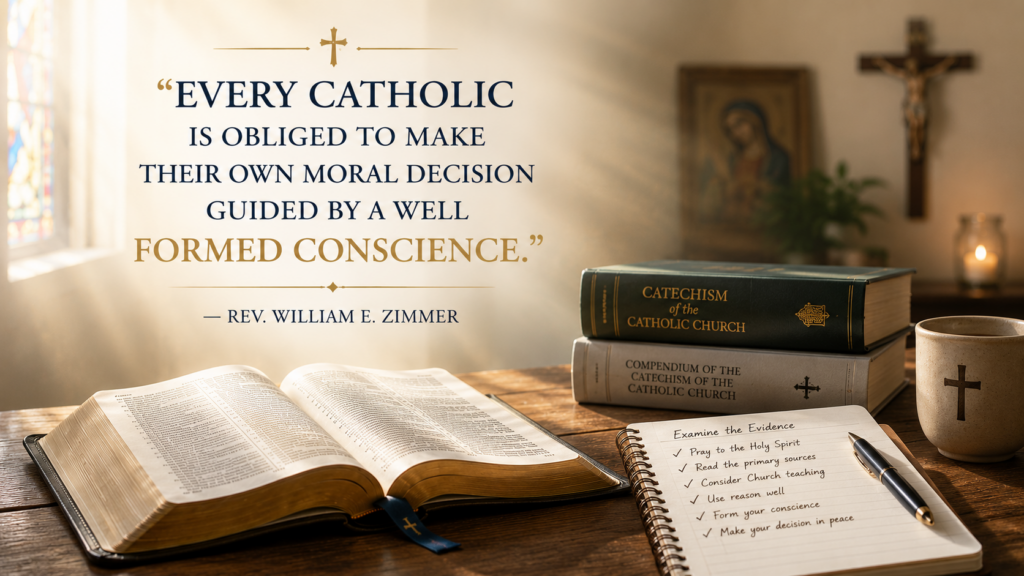
This includes moral decisions that involve complex and controversial issues. Every Catholic is obliged to make their own moral decision guided by a well formed conscience. Making the right moral decision depends on using the right method.
Method for Catholic Moral Decision Making
To illustrate this method of Catholic moral decision making we will consider the moral question: To obtain a COVID-19 vaccine or not.
1. Pray to the Holy Spirit for guidance This essential step should be performed throughout the moral decision making process.
2. Approach the question with an open mind. Begin the analysis with each of the options – to vaccinate or not – having an equal chance of becoming your decision. This means not uncritically jumping on bandwagons – either way – before beginning the process.
This is a biblical teaching: “Those who plead the case first seem to be in the right; then the opponent comes and cross-examines them.” (Proverbs 18:17)
Here is an explanatory comment of this verse by the bible scholar who translated the Book of Proverbs from the original biblical language – ancient Hebrew – to modern American English:
“A persuasive speech in court can easily make one forget there is another side to the question. When the other party speaks, people realize they made a premature judgment. The experience at court is a lesson for daily life: there are two sides to every question.” 2
This is also common sense: Making up one’s mind about an issue before examining it and looking at all sides of the question is not the path to truth. Doing so risks being an exercise in laziness, caving in to the ego or allowing yourself to be led astray by other people’s opinions, perspectives or agendas.
3. The following principles are paramount and must guide the process:
The primacy of human life. All humans are made “in the image and likeness of God” (Gn 1:27). In particular Catholics are “temples of the Holy Spirt” (1 Cor 6:19) by virtue of the sanctifying grace received in the sacraments. Therefore human life is always to be protected and fostered.
Promote the common good. Christians do not live just for themselves or even their families but for the benefit of the society they live in and the larger world.
Take all the factors relevant to the decision into account, not just one 3. For example, the fact that the Pfizer vaccine used a cell line derived from a cell of the kidney of a baby aborted in 1972 as part of the testing regimen for its vaccine is certainly an important consideration in deciding whether to accept that vaccine. However that is not the only factor relevant to this moral question. Others are: the fact that large millions of people across the world are being infected with the corona virus and are suffering and dying as a result; the huge economic dislocation resulting from the pandemic; the disruption of education and social life; a large portion of the healthcare profession stating that vaccines such as Pfizer can help protect the population from the pandemic.
Read the primary source first before consulting secondary sources. For example, in the case of a papal pronouncement, the papal document or transcript of a talk by the Pope should be read first. Then, if you wish, consult secondary sources such as commentaries, analyses, opinions etc. about the papal pronouncement. In no case should you use secondary sources to form an opinion without consulting the primary source first (unfortunately this often happens regarding papal documents and pronouncements, people form an opinion based solely on secondary sources such as the media – in many cases only the secular media – without reading what the Pope himself actually said or wrote!).
Case Study from Scripture
Consulting the primary source first is another way of expressing the common sense principle of obtaining the testimony of the accused before a judgment regarding an allegation against him/her is reached. This is an ancient juridical principle that goes back to the time of the Roman empire. This is revealed in the New Testament in the account of Paul before King Agrippa. The procurator Festus says to the king, “… the chief priests and the elders of the Jews brought charges against him and demanded his condemnation. I answered them that it was not Roman practice to hand over an accused person before he has faced his accusers and had the opportunity to defend himself against their charge.”
This is what happened according to the account in the following section, King Agrippa Hears Paul, “Then Agrippa said to Paul, “You may now speak on your own behalf.” So Paul… began his defense. “I count myself fortunate, King Agrippa, that I am to defend myself before you today against all the charges made against me … I beg you to listen patiently…” After Paul’s statement of self defense the king, the governor and Bernice “… said to one another, ‘This man is doing nothing [at all] that deserves death or imprisonment. And Agrippa said to Festus, “This man could have been set free if he had not appealed to Caesar.”(Acts 25:15-16; 26:1-3,31-32). 4
Use only statements, data etc. within the full context in which they appear. Do not accept or take into account statements lifted out of the larger context in which they originally appeared. This can lead to distorted and even erroneous ideas of what the statement, data etc. are really saying. This method of using information makes one vulnerable to manipulation by the one presenting data that is divorced from its context.
- Perform an unbiased investigation of each side of the question:
TO VACCINATE OR NOT TO VACCINATE FOR COVID-19: THAT IS THE QUESTION
Arguments, data, evidence etc. Arguments, data, evidence etc. for
IN FAVOR OF VACCINATION NOT BEING VACCINATED
- Keeping the above principles in mind evaluate the evidence for each option and draw a conclusion.
- Keep an open mind regarding your conclusion. Be willing to change it if subsequent evidence comes to light that indicates your original conclusion was not the best. This can easily happen when you are deciding complex and controversial issues such as whether to vaccinate or not for COVID-19. Ongoing research, experimentation, scientific and statistical monitoring of the situation etc. can produce new data that was not available at the time of your original investigation and decision.
All this sounds like a lot of time and work for a complex and controversial issue. Is there another way to come to a good moral decision?
Yes. Catholics can – and should – follow the teachings and example of the Holy Father. He is the Vicar of Christ on earth and is informed by the best theological minds in the Church. The Dicastery for the Doctrine of the Faith in the Vatican performs a thorough and objective assessment of major moral issues such as the question of COVID-19 vaccination. They also have access to the top authorities and minds in a given field when performing moral assessments. One of the Vatican’s most valuable services to the Universal Church is that they do the hard, time consuming work described above for us! They also do it much better than most of us can because of the expertise, data and other key resources available to the Vatican.
We are the sheep and the pope is our shepherd. We should obey him, especially on important moral issues. True obedience means obeying the Pope at all times, even when we have a different way of thinking about an issue and even when we disagree with his position. He exemplifies the truth in word and action.
This of course goes against the individualism, relativism and subjectivism of the profoundly secular culture we are immersed in every day. Nevertheless, obeying and following the example of the pope is pleasing to the Lord (whom the pope reports to) and an important aspect of Catholic spirituality. It is assurance that our moral decisions are pleasing to the Lord. This is the path to eternal life. It is also necessary to achieve the perfect unity Christ wills for His Church, “… that they may all be one, as you, Father, are in me and I in you, … so that they may be one, as we are one, I in them and you in me…” (Jn 17:21-23). This applies to all matters, including those that do not involve papal infallibility.
Here are the links to the Vatican and USCCB documents that provide a fuller discussion of the moral issue regarding COVID-19 vaccination:
When you need hope look to the pope! When you need light keep him in sight!
The moral obligations of all the faithful regarding COVID-19 vaccines
Those who accept a vaccine that used cell lines derived from cell(s) from an aborted child have a moral obligation. They should contact the firm that produced the vaccine, i.e., Pfizer, Moderna etc. and inform them that:
those who recognize the fact that life begins at conception should not be forced into the moral dilemma of being vaccinated against their conscience (with a vaccine having a connection to abortion) or not being vaccinated at all.
using cell lines related to abortion is unnecessary. There are other sources for cells adequate for research, development, testing and production of vaccines. Some of these sources might be cells from miscarried or stillborn babies, umbilical cords etc.
www.Pfizer.com www.Moderna.com
Those who choose not to be vaccinated are morally obligated to minimize the chance they will spread the virus to others, particularly the most vulnerable such as the elderly, sick and infirm. This means the unvaccinated must wear masks whenever in public, maintain physical distance of six feet or more and sanitize their hands frequently.